
Dan Kluger is the chef at ABC Kitchen and this year's award winner for Best New Chef from the James Beard Foundation. He is a great supporter of our produce as well as proponent for Greenmarket. Here's a little story about him.

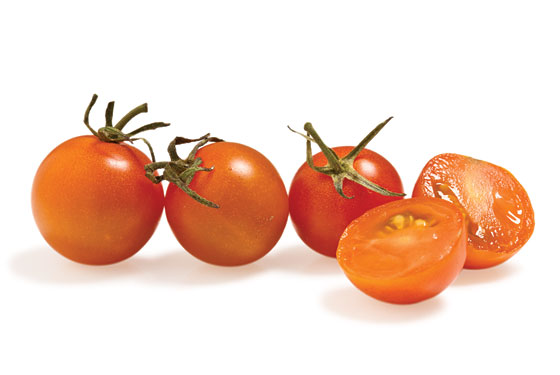
Cherry tomatoes are the M&M’s of the tomato world—compulsively edible, and, at their best, nearly as sweet. And when it comes to cherries, the Sun Gold variety, a popular hybrid developed in Japan, effortlessly dominates. Off the charts in sugar and acid, it swept the top spots in our undercard match, a “dessert course” to the main event. Eckerton Hill’s “amazing” Sun Golds took first place, followed by Keith’s Farm’s, with S. & S.O.’s and Windfall’s tying for third. Avid grower Goldman, in particular, was besotted with Windfall’s juicy little flavor bombs, which she nibbled contemplatively, scrutinized for color (some pink at the top and bottom made her question their classification), and rated as “excellent.” She was so taken with them, in fact (Sun Gold or no), that she asked if she could pocket two to take home—“for the seeds,” she explained, in the manner of a true tomato obsessive. “I have no shame.”

Slowed Food Revolution
Obama seeks to boost demand for organic food but doesn't offer meaningful support for the people who grow it.
Morse Pitts has been cultivating the same land in New York's Hudson Valley for 30 years. His operation, Windfall Farms, is the very picture of local, sustainable agriculture. From early spring to late fall, the farm's 15 acres are luxuriant with snap peas, squash, mint, kale, and Swiss chard. Its greenhouses burst with sun gold tomatoes and an array of baby greens. Pitts, who is in his 50s and is tall with gray hair, doesn't use chemical fertilizers or pesticides or any genetically modified seeds. He cultivates biodiversity, not just vegetables.
Twice a week, he hauls his produce 65 miles south to Manhattan to sell at the lucrative Union Square farmers market. His converted school bus runs on biodiesel he makes from used vegetable oil, which he is also trying to use to power his greenhouses. Pitts does a brisk trade; demand for his produce is high, and the way he farms is increasingly valued. Since the mid-1990s the number of farmers markets has shot up 300 percent, and the organic sector has seen annual double-digit expansion.
But despite having no mortgage debt (he inherited the place), a ready market, and loyal customers, Pitts wants to leave his farm. His town recently rezoned the area as industrial, and if he wants to cultivate soil that's not surrounded by industry and its attendant potential for water and air pollution, he has to move. The problem is, he can't afford to.
Aside from the standard instability farmers must endure -- bad weather, pests, disease, and the vagaries of the market -- holistic and organic growers face great but often overlooked economic hardship. They must shoulder far higher production costs than their conventional counterparts when it comes to everything from laborers to land. Without meaningful support from the U.S. Department of Agriculture, their longevity hangs in the balance. In the meantime, the USDA showers billions on industrial agriculture. Growers who've gone the chemical, mechanized route have ready access to reasonable loans, direct subsidy payments to get through tough years, and crop insurance, plus robust research, marketing, and distribution resources. Whether organic and holistic growers raise crops, like Pitts does, or grass-fed, free-range livestock, they must contend with circumstances made harder by a USDA rigged to favor industrial agriculture and factory food.
Heather Rogers is the author of Green Gone Wrong: How Our Economy Is Undermining the Environmental Revolution and a senior fellow at Demos.

As you may know, timing is key in life. If you don’t get something done at the right time, you may lose your opportunity to make it work. That is especially true in the world of farming. Things need to happen when they need to happen. Of course there’s wiggle room, but you don’t want to push it. So when a key piece of equipment (a roller/crimper) for our research plots decided that it didn’t want to work when we needed it, or when the pepper plants that were specifically for the research got planted in another area by mistake, or when we didn’t have any irrigation set up to water the newly planted plants my initial reaction wasn’t exactly optimistic. We probably should have tested out the roller/crimper before we needed to use it. The pepper plants should have had a sign on them explaining they were set aside for a specific use. Relying on the weather forecast that promised rain but didn’t deliver might have been a bit hopeful. Should have, could have, would have.
Fortunately, equipment was repaired, more pepper plants were found, and make shift irrigation was arranged. Big sigh of relief. Even though some things didn't work out as planned, many things did - like Hubert flame weeding one of the rows. Check it out.
Now we are past the initial implementation stages and dealing with maintenance. There will continue to be setbacks, but somehow it will all work out.

 Reported on our Facebook page:
These are temporary "nuke" hives. We will have to transfer the comb and bees to their permanent hives during the next few days. Fun!

 Windfall Farms has always been interested in experimenting with new methods for accomplishing our goal of providing quality produce with minimal impact to the environment. For example, we currently make biodiesel at the farm (from used cooking oil we pick up at restaurants in the city) to power our tractors, market buses, and small machinery. However, not all endeavors (even if they are embarked upon with the best intentions) turn out to be something economically or practically feasible.

Start planning your menu with our projected Spring produce list!
Late Winter / Early Spring
Parsnips Often considered a Fall storage crop, Parsnips are actually one of a handful of root vegetables that will survive the winter and taste all the better for it in the Spring. Medium and larger specimens are great for cooking in a multitude of ways, while the smaller are tender enough for eating raw and taste like carrots.
Chicory Chicory tastes best in the Spring. Seeds planted in the Fall lay dormant in the field through the winter and germinate as the ground thaws. As a result, the plants release sugars to keep them from freezing. This sweetness compliments Chicory’s naturally bitter flavor, creating an unusually delicious beer-like effect on the palette. We have a wide selection of Chicory this year: Clio, Dandelion, Endive, Frisée, Grumolo, Puntarelle, Rosa di Treviso (a type of Radicchio) and more.
Mâche Originally native to the French alps, Mâche is cultivated in our greenhouses through the cold season. It’s a favorite Winter/Spring green because of it’s distinct buttery, nutty flavor and tender leaves.
Claytonia (Miners’ Lettuce) Very mild and juicy, it will fill-out the stronger flavors of any salad.
Fava Greens The tender leaves are still a lesser known delicacy. They are also more readily available for harvest than the beans.
Spinach Spinach plants thrive and taste best amidst cool growing conditions. When it gets too hot it will go to seed and disappear. Get it while the getting is good and ignore its inferior Californian cousins at the grocery. Varieties: Bloomsdale, Bordeaux, Giant Winter, Olympia, Space, Tyee.
Lettuce Lettuce also thrives in the Spring months when the cool, wet weather prevails. Varieties: Buttercrunch (Bibb), Parris Island Cos (Romaine), Red Iceberg, Red Salad Bowl, Rouge d’Hiver, Tom Thumb (Butterhead), Webb’s Wonderland, Winter Density (Bibb), Winter Marvel, Winter Wonderland and more.
Micro Greens The number of varieties of our exclusively greenhouse-grown micros increases in early Spring and is then reduced as field crops become more abundant. In addition to our year-round favorites (Sunflower, Buckwheat, Purple Radish, Hong Vit, Micro Mesclun), depending on Greenhouse conditions, we have a number of other selections (Kale, Red Mustard, Golden Frill, Tatsoi, Ruby Streaks, Arugula, Chickweed, Purslane, Amaranth).
Later Spring
Sugar Snap Peas They should be called “Spring candy.” Accept no substitutes.
Fava Beans The Spring months are not always long enough to have a significant amount of Fava, but whatever we don’t eat for ourselves, we’ll bring to market.
Sorrel A strong lemony flavored green. The smaller leaves can usually be found in our Mesclun salad mix. Larger leaves are great for flavoring any number of dishes and are often recommended with fish.
Mint “The Best” is the name of the variety we grow. It is.
 I spent a couple of nights walking around in the snow with a tripod at the farm this past Winter. I snagged some really beautiful shots, appearing much like daytime. I hope to find a use for them, and at least share many of them with you here, especially since it is now Spring!


.JPG) Hubert transporting the Turnips
Hubert transporting the Turnips Turnips in a freshly dug hole, as deep as the tractor bucket could dig.
(1).JPG) Bringing some hay bales for insulation.
Bringing some hay bales for insulation. A one-hay bale thick layer on top of them.
 Covered with soil. Goodbye 'til we need ya!
 What you don't see is our depleted root cellar storage before this picture. This is Hubert returning to the buried turnips to dig em up over 6 weeks later.
 There's turnips in there!
 It's definitely a turnip . . . in good condition. Success!
 Harvesting the turnips from the ground, once again.
Radishes, which get sweeter as the weather grows colder, are a great winter crop. Morse Pitts of Windfall Farms has tips for growing, storing, and eating watermelon radishes--and tells you why they go great with salsa
 |
(Photo: Hannah Whitaker. Illustrations: John Burgoyne) |
It’s root-vegetable season, and if that doesn’t make you want to clap your hands and jump up and down, the so-called Gilfeather turnip might. Developed by Vermont farmer John Gilfeather in the late 1800s and recently introduced at Greenmarket’s Windfall Farms stand, the heirloom root (which is actually a rutabaga, Gilfeather’s nomenclature notwithstanding) has a sweet flavor with a mild radishlike bite, and it’s not too much to say it’s the best-tasting rutabaga around. Try a few grated raw in a salad, mashed with potatoes, or in this Finnish pudding recipe from Gastronomica editor and rutabaga authority Darra Goldstein, whose passion for the much-maligned veggie might only have been matched by John Gilfeather himself.
Darra Goldstein’s Finnish Rutabaga Pudding
2 1/2 pounds Gilfeather rutabagas
2 eggs
1/2 cup milk
1/2 tsp. salt
1/2 tsp. freshly grated nutmeg
Dash allspice
3 tbs. all-purpose flour
1 tbs. unsalted butter, softened
2 tbs. bread crumbs
Preheat oven to 350. Butter a 1½-quart soufflé dish. Peel and (1) cube the rutabagas, and boil in salted water to cover until soft, 25 to 30 minutes. (2) Drain and mash by hand. Beat in eggs 1 at a time, then add milk, salt, spices, and flour. (3) Turn mixture into soufflé dish. With a fork, mash together the butter and bread crumbs and spread over the top of the rutabaga mixture. Bake, uncovered, for 1 hour, until lightly browned. Serves 6 to 8 (adapted from The Vegetarian Hearth: Recipes and Reflections for the Cold Season, by Darra Goldstein; HarperCollins, 1996).

